[CLOSED] Second Phase: Call for Good Practices for Reducing Maternal and Neonatal Mortality Based on Primary Health Care
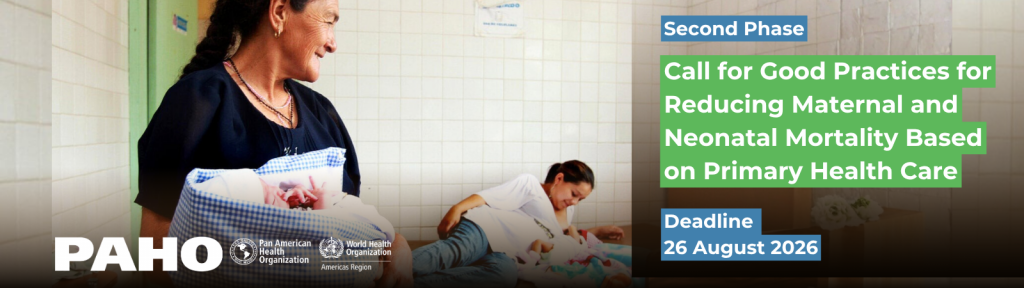
The Pan American Health Organization (PAHO), through its Department of Health Systems and Services and Department of Evidence and Intelligence for Action in Health, invites national government authorities, intergovernmental organizations, non-governmental organizations, civil society organizations, academic institutions, and experts to participate in the second phase of the Call for Good Practices for Reducing Maternal and Neonatal Mortality Based on Primary Health Care.
This second phase builds on the first stage of the call, which was open to national government authorities and intergovernmental organizations, and broadens participation to include additional actors working to reduce maternal and neonatal mortality in the Americas. The good practices selected during the first phase are already being disseminated through PAHO’s Good Practices Portal, contributing to the visibility of successful experiences and supporting the exchange of knowledge across the Region.
The purpose of this initiative is to recognize, document, and disseminate replicable experiences that contribute to accelerating the reduction of maternal and neonatal mortality in the Region, within the framework of the call to action “Zero Preventable Maternal Deaths in the Americas” and in alignment with the Sustainable Development Goals.
Proposals may be submitted in English, Spanish, Portuguese, or French and must be submitted exclusively through PAHO’s Good Practices Portal by 26 August 2026 (11:59 p.m. EST).
General Information about the Call
PAHO seeks to highlight and disseminate replicable experiences that contribute to reducing maternal and neonatal mortality in the Region by promoting the health and well-being of populations. This call for proposals is highly relevant and in keeping with the six strategic lines described in the Call to Action Zero Preventable Maternal Deaths in the Americas issued by the Director of PAHO in June 2024.
Disseminating successful experiences and fostering cooperation among countries are crucial to scaling up effective solutions and adapting them to a range of different contexts, maximizing the impact of public health actions. Focusing these initiatives on primary care ensures broader, more equitable, and sustainable access, in line with the principles of universal coverage.
Furthermore, progress in reducing maternal and neonatal mortality contributes directly to the achievement of the SDGs, particularly:
- SDG 3: Good health and well-being.
- SDG 1: No poverty
- SDG 2: Zero hunger
- SDG 4: Quality education
- SDG 6: Clean water and sanitation
- SDG 8: Decent work and economic growth
- SDG 10: Reduced inequalities
- SDG 16: Peace, justice, and strong institutions.
This Call is CLOSED for submissions.
Participantes:
- National government authorities: Government authorities, including ministries, national agencies, subnational agencies, such as local or regional governments, and other public entities reporting directly to the government; academic institutions*; and civil society organizations*.
- Intergovernmental organizations: The United Nations and its funds and specialized agencies, and other similar organizations.
- International agencies and organizations: Including those with subregional scope, as well as other strategic actors, such as non-governmental organizations — including foundations, religious institutions, and charitable organizations — media organizations, and research institutions*.
- Experts from the Region: Professionals, policymakers, and researchers with publications or involvement in research related to maternal and neonatal mortality.
Languages:
- English
- Spanish
- Portuguese
- French
Submission deadline:
26 August 2026 (11:59 p.m. EST).
Submission of proposals
- Create an account by clicking on “Submit Your Good Practice” in the top menu.
- Document and submit your proposal following the instructions outlined in the Guide for Proposal Submission and the Terms of Reference for the Call.
Only proposals submitted through PAHO’s Good Practices Portal will be accepted. Proposals submitted through other means will not be considered.
Each author may submit a maximum of two (2) proposals within this call.
If any issues are identified or additional information is required, the person responsible for the proposal will be notified via email. Once the requested information is provided, the good practice proposal can be resubmitted for a new evaluation.
Technical Review Committee
A recognition is extended to the following members of the Technical Review Committee for this Call for Good Practices who will carry the technical assessment of the proposals received:
| Name | Affiliation |
|---|---|
| Rodolfo Gómez Ponce de León | Pan American Health Organization |
| Pablo Durán | Pan American Health Organization |
| Claudio Sosa | Pan American Health Organization |
| Thais A. Forster | Pan American Health Organization |
| Lorena Binfa | University of Chile |
Announcement of results
The result of the Call is now published and available for consultation on this Portal.
You may also find interesting
- Department of Health Systems and Services
- Strategy for accelerating maternal mortality reduction in the Region of the Americas based on Primary Health Care
- Access to sexual and reproductive health services in the Region of the Americas
- Zero Maternal Deaths from Hemorrhage
*Note: PAHO Member States require that collaborations with non-State actors be subject to due diligence review and risk assessment in accordance with the Framework of Engagement with Non-State Actors (FENSA). In general, FENSA does not apply to engagements with governmental entities or intergovernmental organizations. However, engagements with State-owned enterprises, foundations, or universities, both public and private, remain subject to review under the framework. Accordingly, non-State actors participating in this Call are requested to review and complete the forms “Information requested from non-State actors for engagement with PAHO/WHO” and “Tobacco and arms-related disclosure statement for non-State actors,” together with their attachments (ANNEX IV of the terms of reference), and to submit them at the Institutional Review step of the Portal submission form.